 By Dr. Taylor, Aesthetic Medicine Specialist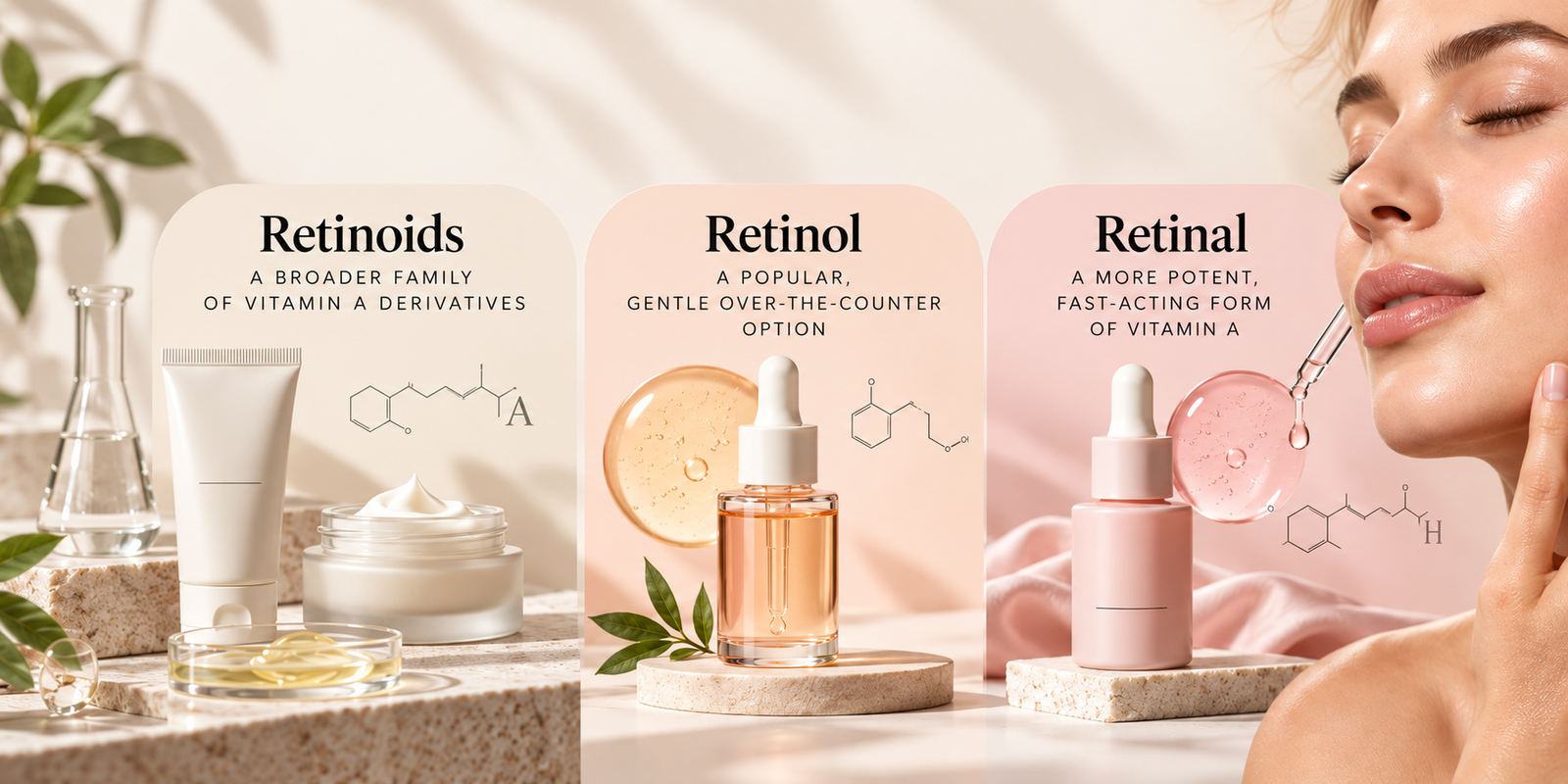
Retinoids are some of the most studied ingredients in dermatology, but the names can be confusing. Many people use retinoid, retinol, and retinal as if they mean the same thing. They do not. Retinoid is the umbrella term for vitamin A derivatives used on the skin; retinol and retinal are two specific members of that family.
If you want the short version: retinal is usually stronger and faster than retinol, while prescription retinoids such as tretinoin, adapalene, and tazarotene generally have the strongest evidence and the highest irritation potential. Which one is best depends on your skin goals, your tolerance, and whether you need over-the-counter care or prescription treatment.
Quick answer: retinoids vs retinol vs retinal
Retinoid is the broad category. Retinol and retinal are both retinoids, but they are not the same strength. In the skin, retinol has to be converted to retinal and then to retinoic acid, while retinal is already one step closer to retinoic acid, the biologically active form. That is why retinal is generally considered more potent than retinol, though it can also be more irritating. Prescription retinoids bypass some of that limitation and are usually the most effective overall, especially for acne and more established photoaging.
What does “retinoid” actually mean?
In skincare, retinoid refers to a family of vitamin A derivatives. This includes over-the-counter forms such as retinol and retinaldehyde, as well as prescription products such as tretinoin, adapalene, tazarotene, and trifarotene. Oral isotretinoin is also a retinoid, but that is a very different medication and not the focus of this article.
What matters clinically is that different retinoids do not behave identically. They differ in how directly they act in the skin, how much evidence supports them, how stable they are in formulations, and how likely they are to cause dryness, peeling, redness, or stinging.
Retinoids vs retinol vs retinal: side-by-side comparison
| Term | What it means | Where you usually find it | Relative strength | Best practical use |
|---|---|---|---|---|
| Retinoid | The umbrella term for vitamin A derivatives used on skin or, in some cases, taken by mouth. | Both over-the-counter and prescription products. | Varies widely. | Useful as a family name, not a single ingredient. |
| Retinol | An over-the-counter precursor that must be converted in skin before it becomes retinoic acid. | Serums, creams, and anti-aging products. | Usually gentler and slower than retinal. | Often a reasonable starting point for beginners or more sensitive skin. |
| Retinal | Also called retinaldehyde; another over-the-counter precursor, but one conversion step closer to retinoic acid. | Serums and creams, often marketed as a stronger nonprescription option. | Usually stronger and faster than retinol. | A good middle ground for people who want more activity than retinol without moving straight to prescription treatment. |
| Prescription retinoids | Examples include tretinoin, adapalene, tazarotene, and trifarotene. | Prescription products; adapalene 0.1% is also available over the counter in the U.S. | Usually strongest, with the best evidence for acne and strong evidence for some signs of photoaging. | Best when you need more predictable acne treatment or stronger rejuvenation, and can tolerate closer medical guidance. |
Which one is strongest?
For the common topical forms, the usual potency ladder is: retinyl esters < retinol < retinaldehyde < retinoic acid. The tolerance ladder generally goes in the opposite direction: milder products are often easier to stick with, while stronger products are more likely to irritate. That does not mean stronger is always better; a product only works if your skin can use it consistently.
Tretinoin, which is a topical retinoic acid, remains the best-established retinoid for photoaging in the published literature and is still widely described as the “gold standard” for skin rejuvenation. At the same time, even tretinoin has limits: FDA labeling makes clear that it improves certain signs such as fine wrinkles, roughness, and uneven pigmentation, but it does not erase wrinkles or reverse skin aging completely.
Retinal is often the strongest over-the-counter option people use for cosmetic purposes, and it may offer a better balance of speed and tolerability than retinol for some users. However, over-the-counter evidence is more variable because formulations differ so much in concentration, stability, and delivery systems. In other words, a well-formulated retinol can outperform a poorly formulated retinal in real life. That last point is an inference from the evidence on differing stability and product variability, not a guarantee about any specific brand.
What can each one help with?
Across the retinoid family, the main goals are usually acne, clogged pores, uneven texture, mottled pigmentation, and fine lines related to sun damage. The evidence is strongest for prescription topical retinoids in acne care, and the American Academy of Dermatology recommends topical retinoids as part of acne treatment.
For aging concerns, retinoids can improve cell turnover and support dermal remodeling, which is why they are used for texture and fine wrinkles. But it is important to separate realistic dermatology from marketing language: results are gradual, partial, and highly individual. No topical retinoid stops aging, removes deep folds, or works identically for everyone.
Retinol and retinal can still be useful, especially for mild acne, early texture changes, and pigment irregularity, but the strength of evidence for over-the-counter anti-aging products is less consistent than for prescription tretinoin. Some reviews find benefit, while a systematic review has also pointed out that many over-the-counter retinol studies are low quality or heavily influenced by product marketing.
How to choose between retinol, retinal, and prescription retinoids
If you are new to vitamin A skincare
Retinol is often the easiest place to start, especially if you have dry, reactive, or easily irritated skin. It is usually less intense than retinal or tretinoin, and dermatologists commonly advise starting with the least intense option and building up slowly rather than trying to “push through” significant irritation.
If you want a stronger over-the-counter option
Retinal is worth considering if you want more activity than retinol and you have already shown that your skin can tolerate actives reasonably well. Because it is one conversion step closer to retinoic acid, it is often described as faster or more potent than retinol, though it can still cause dryness and peeling.
If you have persistent acne or want the strongest evidence
Prescription retinoids are usually the better choice when acne is moderate, recurrent, scarring, or not improving with basic over-the-counter care. They are also the more evidence-based route when you want the most predictable results for photoaging. A dermatologist can also help choose the vehicle, strength, and schedule that fit your skin rather than simply giving you the “strongest” product.
If you have deeper skin tones
People with skin of color can benefit from retinoids, but irritation matters even more because inflammation can trigger post-inflammatory hyperpigmentation, meaning dark marks left after irritation or breakouts. Going slowly, moisturizing, and stopping if your skin becomes persistently inflamed is especially important.
How to use retinoids safely
- Apply at night. This is standard advice for many retinoids and helps reduce irritation and practical issues with sun exposure.
- Use a pea-sized amount for the entire face. More is not better; it usually only raises the risk of irritation.
- Start every other night or a few nights per week if your skin is sensitive. Then increase as tolerated.
- Pair with a moisturizer. This can improve comfort and make acne medications easier to tolerate.
- Wear sunscreen during the day. Sun protection is important when using retinoids and also essential if your goal is to treat pigmentation or photoaging.
If your skin becomes very red, burning, cracked, or persistently flaky, that is not a sign that the product is “working better.” It usually means your barrier is overwhelmed and your routine needs to be simplified.
What should you combine them with, and what should you be careful with?
The safest, most evidence-based pairings are simple: a gentle cleanser, a bland moisturizer, and daily sunscreen. For acne, benzoyl peroxide is often combined with topical retinoids in guideline-based care, but the exact way you combine them depends on the product and on your skin tolerance.
Where people get into trouble is layering a new retinoid with multiple other irritating products at the same time. Prescription labels specifically warn about combining tretinoin or adapalene with harsh cleansers, abrasive products, alcohol-heavy toners, and other strongly drying or peeling agents because cumulative irritation can occur. In practical terms, if you are just starting a retinoid, do not also start strong acids, scrubs, or several acne actives on the same nights unless a clinician has guided that plan.
Common side effects and who should avoid them
The most common side effects are dryness, peeling, redness, stinging, burning, and temporary sensitivity. Some people also notice an early “purge” or flare, especially when treating acne, because retinoids change how clogged pores form and come to the surface. That early worsening does not happen to everyone, but it is recognized in product information.
Topical retinoids are generally not a good starting point when your skin barrier is already significantly irritated, very dry, sunburned, or inflamed from conditions such as rosacea or eczema flares. Official product instructions also advise avoiding application to red, damaged, or abraded skin.
If you are pregnant, planning pregnancy, or think you may be pregnant, do not start a retinoid without talking to your clinician. AAD and ACOG patient guidance advise avoiding topical retinoids during pregnancy, and tazarotene has specific pregnancy contraindication concerns.
How long do results take?
Retinoids are a long-game ingredient. With acne treatment, it often takes 8 to 12 weeks or longer to appreciate the full benefit, and some prescription labels note that improvement continues over weeks to months. For fine lines, rough texture, or pigment irregularity, visible change is usually gradual rather than dramatic.
This is one reason the “best” retinoid is often the one you can use consistently without creating so much irritation that you quit. A slightly milder product used regularly is often more successful than a stronger one used aggressively and then abandoned. This conclusion reflects common dermatology practice and is supported indirectly by the known tradeoff between potency and tolerability.
When to see a dermatologist
- If you have moderate or severe acne, acne scars, or dark marks that keep recurring.
- If over-the-counter retinol or retinal has not helped after a consistent trial.
- If you develop significant redness, burning, swelling, or a rash.
- If you are pregnant, trying to conceive, or need a treatment plan that balances acne, pigmentation, and sensitivity.
Final thoughts
If you remember only one thing about retinoids vs retinol vs retinal, make it this: retinoid is the category, retinol is the gentler and slower option for many beginners, and retinal is usually the stronger over-the-counter step between retinol and prescription-strength retinoids. Prescription retinoids still have the strongest evidence overall, but they also ask more of your skin.
The right choice is not the strongest product on the shelf. It is the one that matches your skin goals, your tolerance, and your ability to use it consistently and safely. When in doubt, start lower, moisturize well, protect your skin from the sun, and ask a dermatologist for guidance if acne, pigmentation, or irritation is becoming difficult to manage.